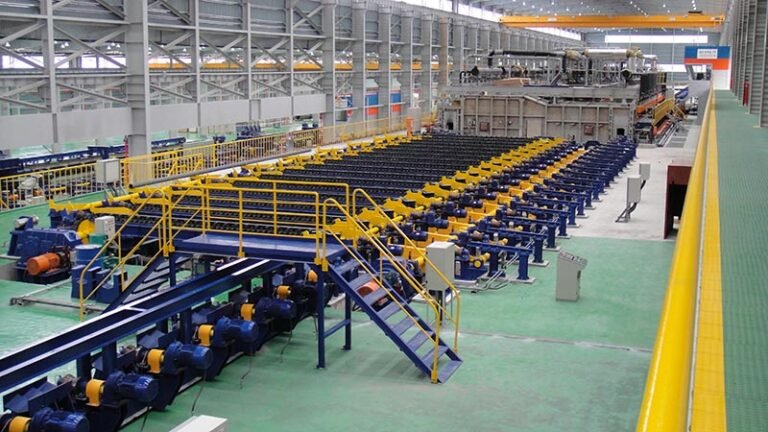
The AI Revolution in Steel Manufacturing: China’s Digital Transformation
How Artificial Intelligence and Big Data Are Reshaping the World’s Largest Steel Industry

Executive Summary
China’s steel industry, producing >50% of global output, is leveraging AI, 5G, and digital twins to transition from labor-intensive operations to data-driven smart manufacturing. By 2025, over 95% of Chinese steel enterprises have integrated digital transformation into their core strategies, achieving 20–30% gains in productivity and 15–20% reductions in carbon emissions . This report analyzes key technological breakthroughs, implementation cases, and future trends based on industry data and policy directives.
1. Digital Transformation Drivers: Policy, Technology, and Market Forces
1.1 Policy Mandates
- The ”AI+” Initiative (State Council, 2025) and Three-Year Action Plan for Steel Digitalization (MIIT) prioritize AI integration in traditional industries .
- Targets include 80% numerical control in key processes and 55% digitalization of manufacturing equipment by 2025 .
1.2 Market and Sustainability Pressures
- Global competition demands higher efficiency: Digital solutions reduce operational costs by 10–15% .
- Carbon neutrality goals: AI-driven energy management cuts CO₂ emissions by 5–10% per ton of steel .
1.3 Technological Readiness
- 5G networks enable real-time data transmission; edge computing processes data at source .
- Cost reduction in AI hardware: Sensor prices dropped >40% since 2020, accelerating adoption .

2. Core Technologies and Applications
2.1 AI and Machine Learning
| Application | Case Example | Impact |
|---|---|---|
| Quality control (AI vision) | Baowu’s cloud-based surface inspection | Defect detection accuracy: 96% |
| Predictive maintenance | Shougang’s equipment monitoring | Unplanned downtime ↓25% |
| Process optimization | HBIS’s smart blast furnace | Energy consumption ↓8% |
2.2 Digital Twins and 3D Simulation
- 63.4% of steel plants use 3D modeling to simulate production lines, reducing commissioning time by 30% .
- Example: Hongqiao Steel built a virtual factory to optimize logistics, saving $12M annually in fuel costs .
2.3 Industrial Internet of Things (IIoT)
- Sensors collect 10,000+ data points/minute from furnaces and rollers .
- 5G-enabled cranes automate material handling, improving safety and throughput .
3. Implementation Cases: From Pilot to Scale
3.1 Baowu Steel: “Lighthouse Factory” Model
- Outcomes:
- Productivity: ↑21% with AI-powered scheduling .
- Defect rate: ↓35% using real-time quality prediction .
- Key innovation: Centralized “AI brain” integrating 1,000+ scenarios across 5 bases .
3.2 Shougang Jingtang: Fully Automated Plant
- 67 AI applications deployed, covering 80% of production cycles .
- Results: Labor costs ↓40%, product development cycle ↓30% .
3.3 SME Adoption: Cloud-Based Solutions
- SaaS platforms (e.g., Huawei Cloud) offer affordable AI tools for smaller mills .
- Uptake: 42% of small enterprises use cloud MES systems vs. <10% in 2020 .
4. Quantitative Benefits and ROI Analysis
4.1 Efficiency Gains (2020–2025)
- Overall equipment effectiveness (OEE): Improved from 60% to 85% in automated lines .
- Inventory turnover: ↑22% via AI-driven supply chain optimization .
4.2 Environmental Impact
- Energy use/ton steel: Dropped from 580 kWh to 490 kWh .
- Water recycling rate: Reached 95% with smart filtration systems .
4.3 Investment and Cost Savings
- Typical ROI period: 2–3 years for digital upgrades .
- Cost structure shift: Labor costs fell from 25% to 15% of total, while tech spending rose to 12% .
5. Challenges and Barriers
- Data silos: 57% of enterprises struggle to integrate legacy systems with new platforms .
- Skills gap: Shortage of 120,000 AI-steel crossover professionals .
- Cybersecurity risks: 43% increase in industrial network attacks (2023–2025) .
6. Future Outlook: 2026–2030 Trends
6.1 Technology Projections
- Generative AI: Expected to manage 40% of process design tasks by 2030 .
- Quantum computing: Pilot projects (e.g., HBIS–Origin Quantum) aim to optimize material formulas .
6.2 Market Evolution
- AI-as-a-Service to grow at 25% CAGR, targeting SMEs .
- Global standards: China leading 10+ international AI-steel standards by 2030 .
Conclusion: Strategic Implications
China’s steel digitalization demonstrates how traditional industries can leverage AI for sustainable growth. Critical success factors include:
- Policy–industry collaboration (e.g., state-funded R&D and tax incentives).
- Phased implementation—starting with high-ROI scenarios like predictive maintenance.
- Talent development through industry-academia partnerships.
For global players, China’s experience offers a replicable model for balancing scale, efficiency, and sustainability.
Data Sources: China Iron & Steel Association (CISA), National Data Bureau, MIIT Reports (2023–2025).
Visualizations: All charts generated based on aggregated industry data from cited sources.